Image Enhancement
Gather Flattening
Ensures improved stack quality, amplitude reliability, and enhanced imaging performance. Precise alignment of reflection events in CMP/CRP gathers through:
- Accurate velocity analysis and refinement
- Residual moveout (RMO) correction
- Anisotropic velocity optimization
- Pre-conditioning for AVO/AVA and inversion studies
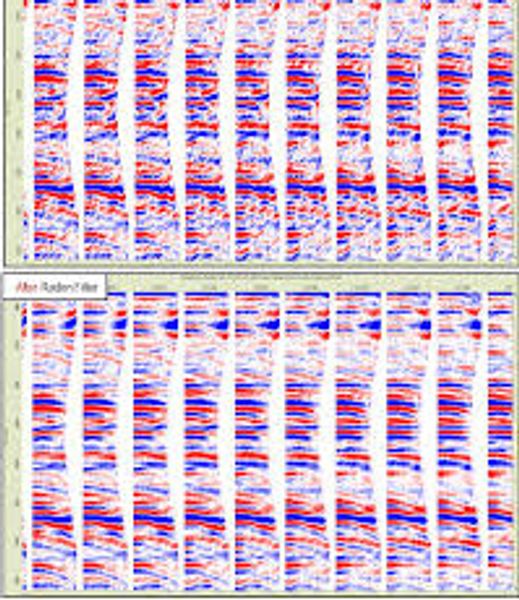
Radon Filtering
Effectively attenuates surface-related multiples, interbed multiples, and coherent linear noise while preserving primary reflections. Advanced Radon-domain processing for multiple attenuation and signal separation:
- Parabolic Radon for residual moveout discrimination
- Linear Radon for coherent noise suppression
- High-resolution Radon transforms
- Adaptive subtraction workflows
Noise Attenuation
Designed to enhance signal-to-noise ratio while maintaining true amplitude fidelity for subsequent imaging and inversion. Comprehensive noise suppression strategies for land and marine datasets:
- Random noise attenuation (FX, FK, Curvelet, Structure-oriented filtering)
- Coherent noise suppression (ground roll, swell noise, guided waves)
- Surface-wave attenuation
- 5D interpolation and regularization
- Signal-preserving denoising workflows

Amplitude & Phase Conditioning
Spectral Balancing / Whitening
Improves vertical resolution and reflector continuity while maintaining stability for AVO and inversion studies. Enhancement of seismic bandwidth and frequency content through:
- Controlled spectral whitening
- Time-variant spectral shaping
- Stabilized deconvolution workflows
- Signal-preserving bandwidth extension
Phase Correction
Critical for accurate structural interpretation and quantitative analysis. Precise phase calibration to ensure wavelet consistency and true reflector positioning:
- Zero-phase and minimum-phase conversion
- Statistical and well-based phase estimation
- Wavelet alignment across offsets and azimuths
- Phase matching between vintages (4D-ready workflows)
True Amplitude Correction
Ensures reliable amplitude behavior for AVO/AVA, elastic inversion, and reservoir characterization. Amplitude-preserving processing workflows designed for quantitative interpretation:
- Geometric spreading correction
- Absorption (Q) compensation
- Spherical divergence correction
- Angle-dependent amplitude preservation
Surface-Consistent Amplitude Correction
Enhances gather consistency and stack uniformity across the survey. Robust compensation of source, receiver, offset, and azimuth effects:
- Surface-consistent deconvolution
- Surface-consistent scaling
- Statics-consistent amplitude balancing
- Compensation for acquisition footprint
Relative Amplitude Balancing
Reduces acquisition-related amplitude variability while preserving geological signal. Trace-to-trace and gather-to-gather amplitude equalization through:
- Offset-dependent scaling
- Trace energy normalization
- Shot and receiver domain balancing
- Survey-wide amplitude homogenization
Envelope Balancing
Enhances reflector visibility and supports structural interpretation in noisy environments. Amplitude envelope normalization for improved event continuity:
- Instantaneous attribute-based scaling
- Time-variant energy balancing
- Structural-oriented envelope equalization
Resolution Enhancement
Spectral Enhancement
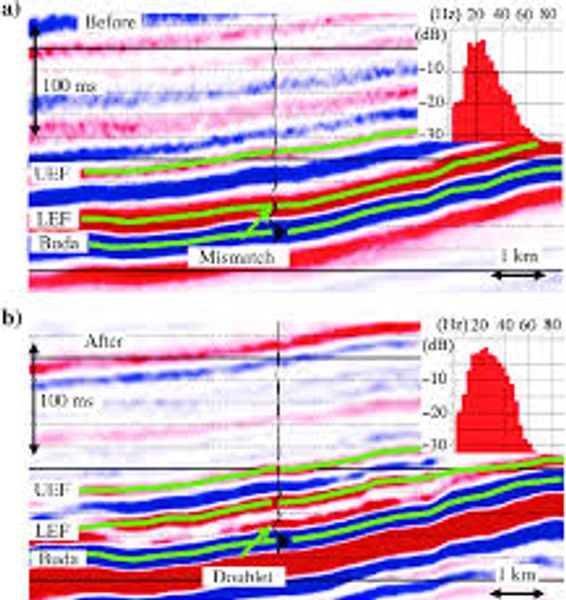
Enhances reflector continuity, improves subtle stratigraphic feature detection, and supports high-resolution interpretation. Broadband optimization of seismic data to improve resolution and interpretability:
- Controlled bandwidth extension
- Time-variant spectral shaping
- Adaptive frequency-domain filtering
- Signal-preserving spectral equalization
High-Frequency Boosting / Q Compensation
Restores high-frequency content lost due to propagation effects, improving vertical resolution while maintaining stability for inversion and AVO workflows. Compensation for attenuation and intrinsic absorption effects:
- Inverse-Q filtering with stabilization control
- Amplitude and phase correction for attenuation
- Time-variant frequency amplification
- Noise-aware compensation algorithms
Spectral Bluing
Provides improved bed resolution and reflector definition without introducing artificial ringing or amplitude distortion. Resolution enhancement through frequency-dependent amplitude rebalancing:
- Emphasis on higher-frequency components
- Controlled spectral tilt correction
- Wavelet sharpening while preserving amplitude trends
- Stabilized whitening alternatives

Structural & Continuity Enhancement
Structure-Oriented Smoothing
Improves signal-to-noise ratio without blurring discontinuities, making it ideal for fault interpretation and stratigraphic analysis. Dip-guided noise suppression that enhances reflector continuity while preserving structural integrity:
- Local dip and azimuth estimation
- Structure-aligned filtering along reflectors
- Fault-preserving smoothing
- Time-variant structural filtering
Tensor-Based Dip-Steering Filtering
Particularly effective in structurally complex areas where conventional filters distort geological features. Multi-dimensional filtering driven by structural tensors for superior reflector preservation:
- Coherency-based dip estimation
- Anisotropic smoothing along structural trends
- Adaptive filtering in complex faulted regions
- Enhanced reflector continuity in noisy datasets
Cadzow Random-Reduction Filtering
Highly effective for improving data quality prior to migration, inversion, and attribute analysis. Rank-reduction filtering in the frequency-space domain for coherent signal preservation:
- Singular value decomposition (SVD)-based noise attenuation
- Random noise suppression via low-rank approximation
- Multi-channel coherence enhancement
- Signal-preserving denoising in shot, CMP, or 5D domains