Seismic Data Processing & Imaging Services

Time Processing (2D/3D)
Comprehensive seismic data processing workflows for both land and marine surveys, including:
- Advanced noise attenuation and signal enhancement
- Surface-consistent amplitude and phase corrections
- Multiple suppression (SRME, Radon, SWD)
- Velocity analysis and model building
- Pre-stack and post-stack processing optimization
- True-amplitude preservation workflows
Delivering high-quality gathers and stacked sections ready for advanced imaging.

Time Imaging
Advanced pre-stack time imaging solutions designed for structurally complex and anisotropic environments:
- Curved-ray anisotropic Pre-Stack Time Migration (PSTM)
- Common Reflection Angle Migration (CRAM)
- Amplitude-preserved time imaging
- Residual moveout analysis and velocity refinement
Optimized for accurate structural positioning and improved fault delineation.

Depth Imaging
State-of-the-art depth imaging solutions for complex geological settings:
- Kirchhoff anisotropic Pre-Stack Depth Migration (PSDM)
- Structural model-based tomography
- Wave-equation Pre-Stack Depth Migration
- Reverse Time Migration (RTM)
- Azimuthal seismic forward modeling and imaging
Delivering high-resolution depth models for subsalt, thrust belts, fractured reservoirs, and anisotropic formations.
Land & Marine Processing
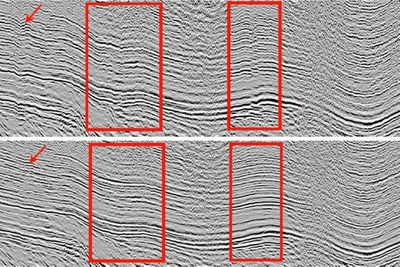
Land statics in complex near-surface
Where the weathering layer varies from loose scree and peat to weathered basalt, we model it from refracted arrivals. First breaks are picked automatically with position-error estimation and interactive editing, and uphole times, LVL surveys and deep upholes constrain the model. We use delay-time, reciprocal ray path, generalised linear inversion and tomographic methods, iterated with velocity analysis, residual statics and noise attenuation.
Coherent and random noise attenuation
FK filtering, FX deconvolution, linear Radon, eigenimage filtering, time-frequency-domain noise suppression, multichannel adaptive subtraction, surface-wave and airblast attenuation, and spike and noise-burst editing. Each tool can be applied in the shot, receiver, offset or cross-spread domain, chosen for the noise problem at hand.
Adaptive deghosting
Source- and receiver-side ghosts are removed by sparse decomposition in the local plane-wave domain, which broadens the usable bandwidth. On a 15,000 km 2D marine reprocessing project, joint source and receiver deghosting recovered the low frequencies.
Bandwidth extension (e-BAND)
e-BAND removes ghost notches by combining the causal ringing in each trace with the anti-causal ringing found in reverse time, rebuilding a trace free of source and receiver ghosts. As with any bandwidth recovery, the gain depends on the frequencies that sit above the noise level.
5D interpolation
Reconstructs missing traces across offset and azimuth from data that are well sampled in the other dimensions. Used for acquisition-footprint removal, merging overlapping surveys, and better sampling for migration and AVO analysis.
Reprocessing legacy 2D and 3D data
Older surveys often hold more than their original processing showed. We reprocess from the field records forward and re-image the data with current time and depth methods. Our simultaneous velocity and anisotropy PSTM has been applied to several hundred 3D volumes and many 2D projects.
Full-waveform inversion (FWI)
For depth imaging we build the velocity model with tomography, refine it with full-waveform inversion on our in-house GPU engine, and migrate with RTM. On the public Viking Graben Line 12 dataset, the inverted model improved the fit on all 47 shots held out of the inversion, raising correlation with the recorded data from 0.38 to 0.78.